
Owyhee Parole and Probation
Parole follows an Idaho prison term and is granted by the Idaho Commission of Pardons and Parole. IDOC Probation and Parole then supervises the person in the community. Probation is ordered by a court instead of, or after, jail or prison time. Adult felony probation is generally administered through IDOC, while Owyhee County Probation handles the county-level matters assigned to that office. The judgment and current agency record settle which system applies.
A jail release alone does not answer the question. Someone who bonds out may have no supervision yet because the criminal case is still open. Another person may leave prison on parole, while a third may complete the custodial part of a sentence and begin probation. Read the event label and the supervising authority.
| Record type | Who orders it | Best verification |
|---|---|---|
| Parole | Idaho Commission of Pardons and Parole | IDOC status, district and Commission action |
| State probation | District court | iCourt judgment plus IDOC client detail |
| County probation | Sentencing court | Court order and Owyhee County Probation |
| Final discharge | Agency or court under the governing sentence | Dated discharge entry or signed order |
- Parole
- Conditional community release after part of a prison sentence.
- Probation
- Court-ordered community supervision with stated terms.
- Absconder
- A supervised person whose location is unknown after failing to report.
- Discharge
- The formal end of the supervision obligation.
Verify Owyhee Post-Release Supervision
The IDOC Resident/Client Search is the main public starting point for state parole or probation. Search by last name and first name, or by IDOC number. Results list an IDOC number, name, birth year, and status. An active detail may show the community district, officer, and a phone number. A discharged result can carry the date in the label. Similar names require a birth-year and case comparison.
- Search the IDOC record with the most precise name or number available.
- Open the correct detail and note whether it says incarcerated, in community, or discharged.
- Read each sentence row for Owyhee as the sentencing county, the case number, release-to-supervision date, and satisfaction date.
- Compare the case number with the court judgment and later supervision orders in Idaho iCourt.
- Call the named officer or district when a live reporting or status question remains.
- Request the source record when a date or agency conflicts with the court file.
Public search data can lag. IDOC warns that its information is updated daily, so an urgent same-day question should be confirmed with the supervising office. The Owyhee jail roster covers current physical custody, not the full history of community supervision.
Owyhee Supervision Office Routes
Owyhee County has two locally relevant routes. The county probation office is in Homedale. IDOC District 3 also lists a Homedale satellite for state parole and probation. They are not interchangeable, and the IDOC satellite does not publish a separate phone. Use the officer contact shown in the client detail or call the District 3 Caldwell office.
8 N. 2nd Street W.
PO Box 126
Homedale, ID 83628
208-337-3702
Monday-Friday, 8:30 a.m.-noon and 1-5 p.m.
3110 East Cleveland Boulevard, Building D
Caldwell, ID 83605
208-454-7601
Homedale satellite: 24 W. Idaho Avenue
The District 3 page confirms that Owyhee County is within the district. The person-specific IDOC detail remains more useful because it can identify the assigned officer and direct line.
Owyhee Supervision Terms and Violations
Conditions vary by judgment, Commission order, and supervision plan. Common high-level duties include reporting as directed, obeying laws, and complying with court or officer instructions. A violation allegation does not itself establish revocation. The court handles probation consequences, while the Commission handles Idaho parole revocation decisions. A person may remain in the community, be arrested on a warrant, or return to custody while the matter is reviewed.
Commission decision labels must be read as written. “Revoke & Grant New Parole,” “Revoke & Set Hearing Date,” and “Revoke & Pass to Full Term Release Date” describe different outcomes. “Grant Parole to Detainer Only” means release into another custody, not the community. The Commission decisions may show a next hearing or tentative parole date, but neither proves a physical release.
Owyhee Supervision Discharge Records
Release to supervision is not final discharge. The IDOC detail may show “In community” during active supervision. A later public result may state “Discharged” with a date. Idaho Code § 20-1012 addresses Commission discharge and certificate authority. The Commission FAQ also describes a final document known as the Gold Seal, which goes to the last supervising district for forwarding and may take up to a month.
For direct proof, request the discharge notice, relevant Commission action, and sentence record. The Owyhee County released inmate search explains how the jail, court, and IDOC records fit together. A court set-aside or Clean Slate result is a separate legal process and should not be confused with correctional discharge.
Owyhee Warrants After Release
The sheriff and Homedale Police warrant list has a narrow purpose. Owyhee County says it updates Monday through Friday between 6 a.m. and noon, except holidays, and warns that changes may not appear at once. Dispatch must confirm any warrant. It is not a release list and absence from it does not prove that supervision is clear.
IDOC's Fugitive Recovery Most Wanted page is selective too. It does not list every alleged absconder. Check the Resident/Client status and supervising authority, then contact the responsible office. The warrant image published by IDOC illustrates that selective channel, not a complete county roll.
View the official IDOC Fugitive Recovery source.
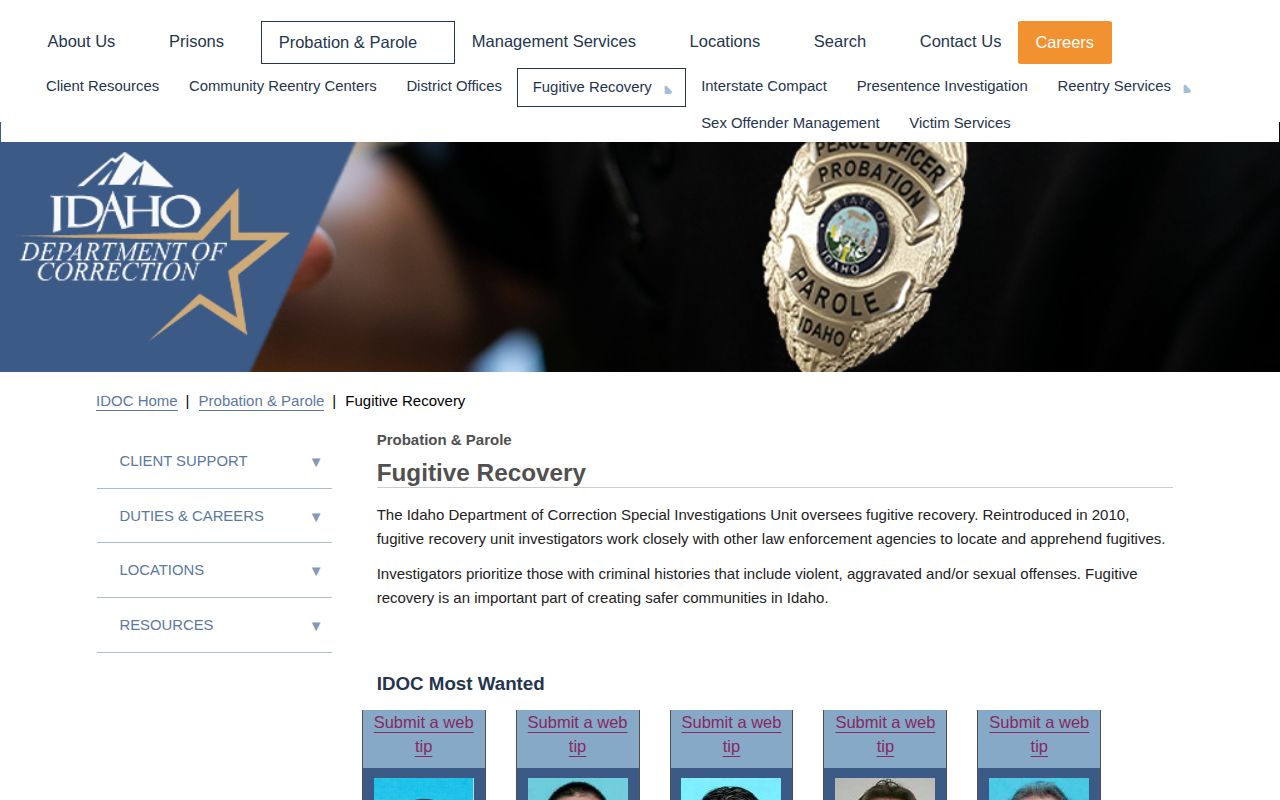
The source should be paired with IDOC client details and dispatch confirmation.
Two Owyhee Supervision Offices
The two Homedale locations are a distinctive local detail. County probation works from 8 N. 2nd Street W., while the state District 3 satellite is at 24 W. Idaho Avenue. A caller should not assume that one office can certify the other's case. Start with the judgment and IDOC detail, identify the agency, then use that agency's contact.
This distinction also prevents a common error after release. A person may have an Owyhee court case but report to an IDOC officer, or may have a county probation matter with no parole component. Agency ownership is more reliable than the county name alone.
The court file supplies the durable legal trail. Read the judgment, any order modifying probation, and a later discharge or set-aside order. IDOC supplies the current correctional trail. Its sentence rows may show the Owyhee case number, the date released to supervision, a satisfaction date, and the current officer. Neither source should be forced to answer the other's question.
Parole hearing records add one more layer. The Commission schedule lists regular and revocation hearings, but a scheduled hearing is not proof that it occurred. Notices of Action Taken provide the actual decision and may include a tentative date. Even a grant remains conditional until the plan, programs, papers, and receiving district are ready.
When the public records conflict, record the date and exact label from each source. Ask the originating agency to explain its own field. A person reconnecting with someone after release can use VINE for a quick status change, yet the supervising office and source documents provide the sound confirmation.
IDOC search fields also help prevent a namesake error. Last name or IDOC number is required, and a partial search accepts at least two surname letters or three number digits. Results provide the IDOC number, full name parts, birth year, and status. Open the detail only after those values align. A detail may show a community district, supervising officer, phone, offense, sentencing county, and case number. Those fields form a stronger match than a name alone.
Final completion requires its own proof. A sentence satisfaction date can apply to one sentence row while another sentence remains active. Likewise, release from physical custody can begin parole rather than end the correctional term. A dated Discharged result, Gold Seal notice, or controlling court order is better evidence that the stated supervision obligation ended.
The Commission's public schedule and decisions are useful when an expected parole path changes. Schedules can move, and the hearing order is posted close to the session. Decisions generally appear as Notices of Action Taken. A next hearing date shows future review. A pass to full term, denial, revocation, or detainer-only grant may explain why a person did not enter ordinary community supervision.
For immediate safety or reporting concerns, use the responsible government office rather than drawing conclusions from a web list. The sheriff's warrant page warns of lag, and IDOC Most Wanted is selective. A documented call should note the date, time, office, and unit that supplied the answer. Written records remain the best way to reconcile a later conflict.
Search Public Records
Sponsored Results